IC-AICSE 2026 to Bring Global AI Research and Engineering Experts Together in Kathmandu
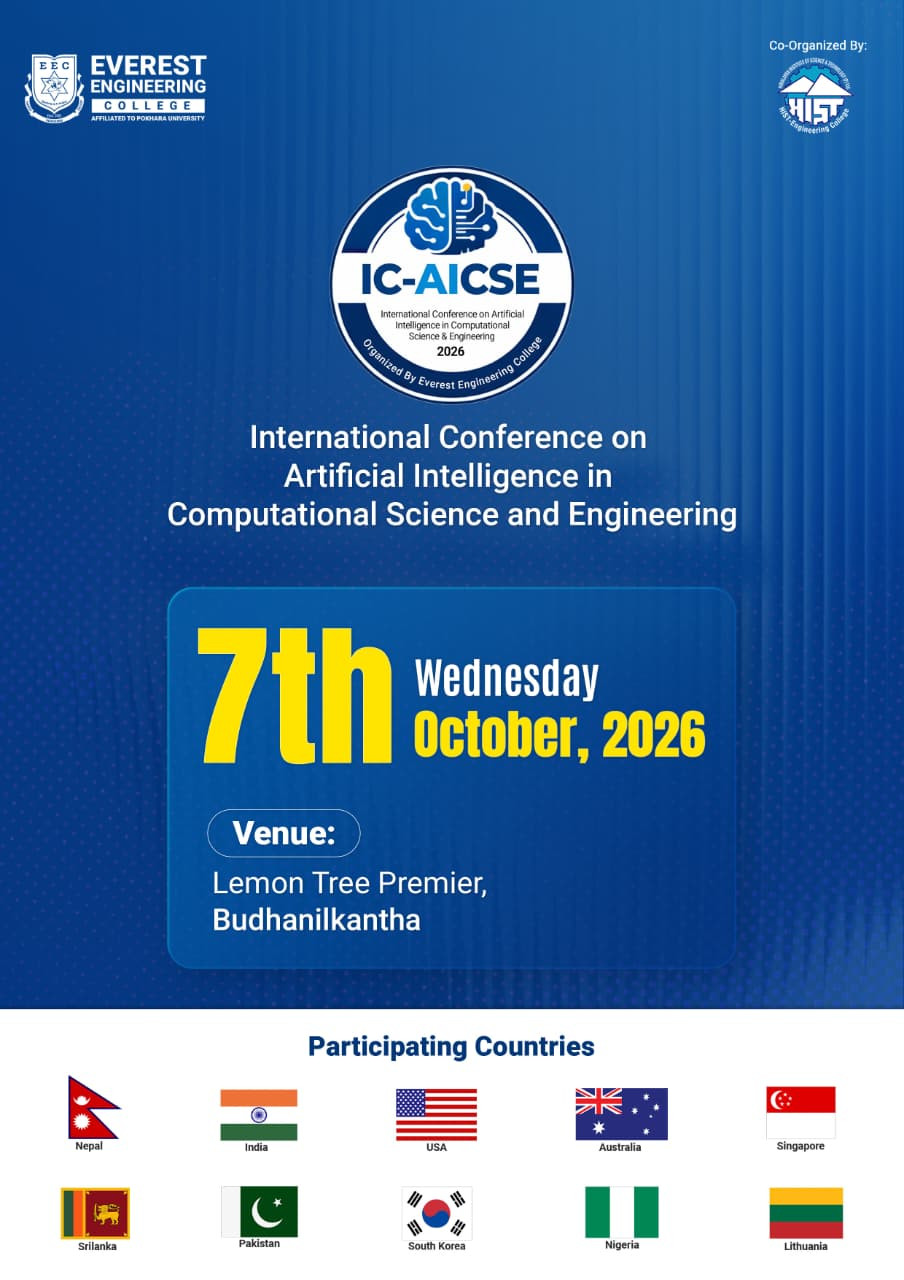
Start Date: 07 Oct 2026
Deadline: 07 Oct 2026
Budhanilkantha,
Kathmandu, October 6, 2026 — Everest Engineering College, Sanepa, in collaboration with HIST Engineering College, is set to organize the International Conference on Artificial Intelligence in Computational Science & Engineering (IC-AICSE 2026) on October 7, 2026, at Lemon Tree Premier, Budhanilkantha, Kathmandu.
The international conference is expected to bring together more than 200 participants, including researchers, academics, engineers, technology professionals, students, and young researchers. More than 40 research papers from 10 countries will be presented during the conference. Research papers selected through an expert peer-review process will be presented in parallel technical sessions.
Conference Leadership
- Chief Guest: Prof. Dr. Chandramani Poudel, Chairman of Bagmati University
- Conference Chair: Prof. Dr. Harikrishna Shrestha
- Member Secretary: Associate Professor Engineer Rajan Lama
Focus on AI, Computational Science and Engineering
IC-AICSE 2026 will focus on the growing role of artificial intelligence in research, education, innovation, and practical problem-solving. The conference will provide a platform for researchers and professionals from diverse disciplines to exchange ideas, share research findings, receive constructive feedback, and explore opportunities for collaboration.
Major Thematic Areas
- Computer Engineering and Information Technology
- Computational Science
- Cybersecurity and Digital Forensics
- Financial Technology
- Civil Engineering and Environmental Science
- Engineering and related interdisciplinary applications
Partnerships and Endorsements
- Technical Support: IEEE Nepal Section
- Knowledge Partner: Nepal Engineers Association
- Recognitions & Support: Nepal Engineering Council and University Grants Commission
Connecting AI Research with Nepal's Local Needs
A key objective of the conference is to encourage discussions on how artificial intelligence can address Nepal's specific needs and challenges. Potential applications include infrastructure assessment, traffic and transportation management, water-resource data analysis, environmental risk identification, and improvement of public services.
Experts emphasize that translating AI research into practical solutions requires more than technological innovation. Reliable data, domain expertise, technological robustness, and a strong understanding of local conditions must work together to ensure that AI-based solutions are effective and relevant.
Platform for Students and Young Researchers
The conference will also provide an important platform for students and emerging researchers to present their work and engage with experienced academics and professionals. Research presentations will help young researchers strengthen their research methodology, improve the use of evidence, and develop their ability to communicate and interpret research findings.
Emphasis on Responsible AI
Alongside technological advancement, responsible and ethical use of artificial intelligence will be a major consideration at the conference. Discussions will highlight the importance of data quality, privacy, fairness, transparency, reliability, and human accountability in the development and deployment of AI-based systems.
Technical Sessions & Paper Schedules
Session Theme: Civil & Environmental Engineering
Session Chair: Dr. Thusitha Chandani Shahi | Date: 07 October 2026
| S.N | Author Name(s) | Paper Topic | Country | Mode |
|---|---|---|---|---|
| 1 | Sandip KC, Pradeep Kumar Shrestha | Assessing the Value of Waiting Time at Narayan Gopal Chowk Intersection, Kathmandu: A Stated Preference Case Study | Nepal | - |
| 2 | Prajwal Chirague Niroula, Bishnu Prasad Devkota | Optimal Siting Fast Charging Stations along the Prithvi Highway using GIS-Based MCDA | Nepal | Physical |
| 3 | Roshan Yadav, Bishnu Prasad Devkota | Predicting E-mobility adoption in Nepal: An Analytical Hierarchy Process and System Dynamics Approach | Nepal | Physical |
| 4 | Devendra Kumar Jha, Mohit Agrawal, A.K. Mishra | To analyse the direct & indirect impacts of Basic Sanitation initiative in Nepal and Citywide inclusive Sanitation (CWIS) as a Way forward for Safely Managed Sanitation | Nepal / India | Online |
| 5 | Abiral Gautam | Flood Risk Monitoring System Using Machine Learning and GIS Techniques | Nepal | - |
| 6 | Pratap Bikram Shahi, Sangita Ghimire, Kul Bahadur Shahi | A Preliminary Treatability Assessment of Textile Industry Effluent in Nepal | Nepal | - |
| 7 | Mega Maskey, Sabina Twayana | Spatiotemporal, Topographic, and Climatic Analysis of New and Small Glacial Lakes in Dudhkoshi River Basin | Nepal | - |
| 8 | Bikram Babu KC | Multi-Objective Deep Reinforcement Learning-Based Spatial Optimization of Green Infrastructure in High-Density Up-Growing Cities | Nepal | - |
Session Theme: Computer Engineering & Information Technology
Session Chair: Dr. Kamal Lamichhane
| S.N | Author Name(s) | Paper Topic | Mode |
|---|---|---|---|
| 1 | Sanjesh Panta, Khagendra Koirala, Anjan Chandra Paudel, Bishow Kaji Shrestha | Detecting Protected Health Information (PHI) in Heterogeneous Email Attachments: A Systematic Review of Local-First, Edge-AI Frameworks | Online / Not Attend |
| 2 | Sushant Poudel, Aashika Pandey, Ashish K Jha | Evaluating Wi-Fi Sensing Attack Vectors: Covert Threat Detection and Mitigation in IoT Ecosystems | Physical |
| 3 | Belmata Bhandari, Sharad Kumar Ghimire | Fiber Anomalies Detection and Localization in Optical Network using GRU-AE and A-BiGRU | Online / Physical |
| 4 | Rajeev Suwal, Pratistha Prajapati, Binay Shrestha, Sandesh Machamasi, Sarbagya Buddhacharya, Yogesh Bajracharya | Multiple Access Using LoRa Communication | Physical |
| 5 | Yaman Sigdel, Shubham Pokhrel, Shaligram Bhatta, Sarbagya Ratna Maharjan, Bipin Thapa Magar | Multimodal Emotion Recognition for Nepali Speakers Using Fused Facial and Audio Convolutional Neural Networks | Online |
| 6 | Avinabh Thakur | A Regularized Multilayer Feedforward Neural Network for Early-Stage Diabetes Risk Prediction | Online |
| 7 | Puja Bist, Prem Singh Bist, Yagya Raj Pandeya | A Unified Deep Learning Framework for Brain Tumor MRI Classification with Domain Adaptation, Ensemble Learning, and Uncertainty Estimation | - |
| 8 | Sangita Sharma | Agentic Retrieval-Augmented Generation with Knowledge-Graph Memory for Quality-Gated First-Response Orchestration in Enterprise Support Systems | Physical |
| 9 | Nayan Raj Pokharel, Sujan Dhungana, Ayush Koirala, Kiran Bagale | PlantDoc: AI-Based Plant Disease Detection App | - |
| 10 | Bhuwan Prasad Joshi, Anshu Bhandari, Ishita Bhatta, Pradeept Jarur Shahi | Legal Divorce Chatbot: A Retrieval-Augmented Generation Based Nepali Legal Question Answering System | Physical |
Session Theme: Artificial Intelligence, Machine Learning & IoT
| S.N | Author Name(s) | Paper Topic | Mode |
|---|---|---|---|
| 1 | Soham Biren Katlariwala, Amina Saeed, Harina Kumari Khati, Mahdisa Moradi | Questioning the Benchmarks: Hidden Circularity in AQ-10 Autism Screening Datasets | Online |
| 2 | Safal Sharma, Apar Poudel, Bidur Devkota | Enhancing Sentiment Analysis of Romanized Code-Mixed Nepali Social Media Text through Monolingual Transformation | Online |
| 3 | Parash Mani Shah, Narendra Sharki, Dipesh Yadav, Mahesh Dahal, Prabhat K.C | Machine Learning Techniques for Tabular Data Classification and Regression: A Systematic Literature Review of Traditional and Deep Learning Approaches | Physical |
| 4 | Kyathrin Chemjong, Rupesh Chaudhary, Prem B. KC | Plant Pest Identification and Treatment Recommendation Using Deep Learning | Physical |
| 5 | Arman Ansari | EdgeQuakeNet: A Federated Transformer Framework for Real-Time Earthquake Early Warning on Resource-Constrained Edge Devices | Physical |
| 6 | Samundra Bhandari, Juhi Jha, Anish Bhattarai, Rahul Chaudhary, Narayan Sapkota | An Ensemble Based Approach for Facial Emotion Recognition | - |
| 7 | Mausam Gurung, Prabin Neupane, Sajjan Acharya | NepScript Genesis: Neural Architecture Search for Handwritten Devanagari Digit Synthesis | - |
| 8 | Utsav Paneru | Please Make it Sound like Human: Encoder-Decoder vs. Decoder-Only Transformers for AI-to-Human Text Style Transfer | - |
| 9 | Sarbin Sayami, Subarna Shakya | Bridging the Resource Gap: Nepali-Assisted Transfer Learning for Low-Resource Nepal Bhasa--English Neural Machine Translation with NLLB-200 and mBART-50 | Physical |
| 10 | Pravin Rana | A Comparative Evaluation of Traditional and Transformer-Based Approaches for Detecting Hate Speech in Nepali Political Content | - |
| 11 | Dharma Raj Ojha, Akhtar Husain, Prakash Datt Bhatt | Design and Evaluation of Machine Learning Models for Predicting At-Risk Students in Universities | - |
Session Theme: Computational Science, Cybersecurity & FinTech
| S.N | Author Name(s) | Paper Topic | Mode |
|---|---|---|---|
| 1 | Om Prakash Panjiyar, Shambhu Gautam | A Hybrid VAE–GAT–Transformer and Signature-Based Intrusion Detection Framework for Zero-Day Attack Detection in Enterprise and IoMT Networks | Physical |
| 2 | Bhupendra Kumar Yadav, Ritesh Dev, Daan B. Ghartimagar, Ganesh B. Singh | Computational Modeling and Multi-Objective Particle Swarm Optimization of a Cam-Actuated Dual-Finger Seedling Separation Mechanism for Non-Mat Rice Transplanters | Physical / No Attend |
| 3 | Rijan Niraula, Ganesh P.S. Kushawa | Deep Learning to Predict the Nature of Line Charge for Given Potential in Unit Sphere. | Online |
| 4 | Apurva Nepal, Manoj Pandey, Prabhat Acharya, Yagya Raj Pandeya | Enhancing the AI-Powered Anti Money Laundering System by Using Adversarial Robust Testing | Physical |
| 5 | Sushant Poudel, Rakhee Pandey | Evaluating Google’s Open Knowledge Format (OKF v0.1) for Multi-Agent Threat Intelligence: A Proof-of-Concept in Digital Forensics | Physical |
| 6 | Ganesh Bhusal | HBPDF: A Hybrid Detection and Prevention Framework for Banking Phishing Scams in Emerging Digital Economies—Evidence from Nepal | Online |
| 7 | Dilli Hang Rai | Hybrid Variational Quantum-Classical Framework with Adaptive Weighting and Efficiency Assessment | Online |
| 8 | Gayatri Sharma, Binod Sapkota | Multi-Objective Feature Selection for Enhanced Efficiency in Phishing URL Detection | - |
| 9 | Binod Bhattarai, Dipesh Gurung | PromptSentinel: Multi-View Anomaly Detection for Black-Box Prompt Injection Defense in Large Language Models | Online |
| 10 | Sudip Subedi, Sudipa Subedi | RARE-AI: Intelligent Risk-Aware Routing for Cross-Border Payments Using Explainable Artificial Intelligence | Physical |