Kathmandu Model College Hosts IJCC 2026: Driving Global Scholarly Dialogues on AI, Convergence, Technology, and Policy
Start Date: 03 Feb 2026
Deadline: 06 Feb 2026
kmc Bagbazar
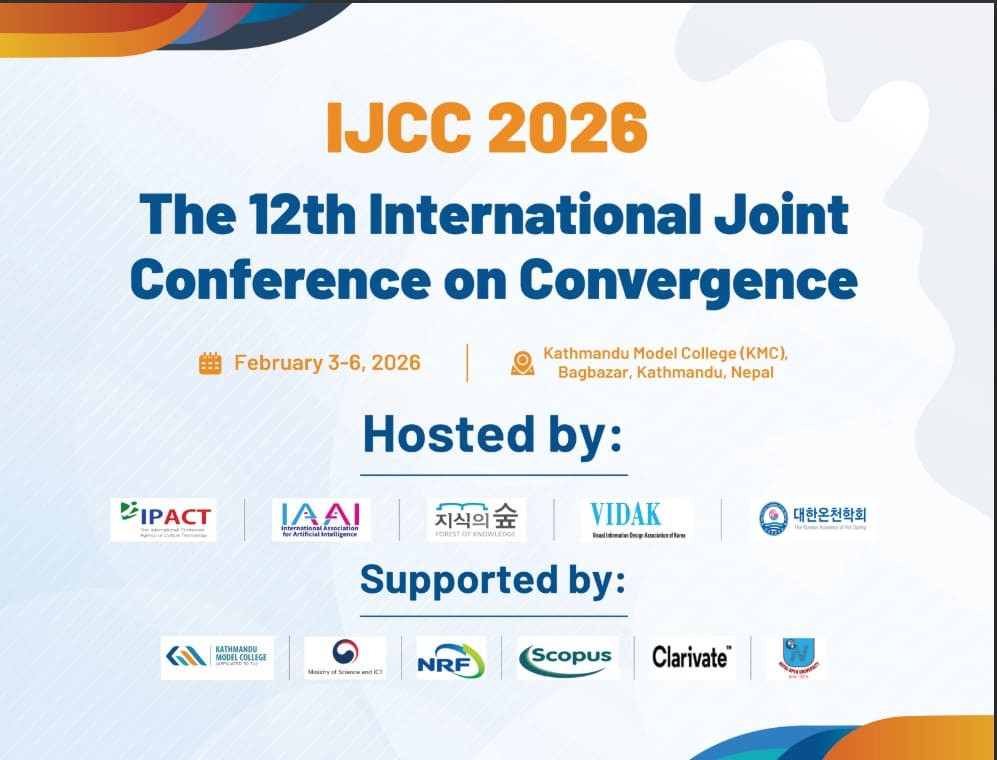
Kathmandu Model College (KMC), Bagbazar, is set to host the 12th International Joint Conference on Convergence (IJCC 2026) from February 3 to 6, 2026, alongside the prestigious Korean-led International Design and Exchange Exhibition from February 2 to 4, 2026. Together, these events position Nepal as a growing hub for global academic exchange in artificial intelligence, convergence technologies, innovation, culture, and sustainability.
IJCC 2026 provides a timely and strategic platform for high-level scholarly discussion, critical debate, and policy-oriented intervention on the rapidly evolving intersections of artificial intelligence, digital governance, sustainability, and interdisciplinary innovation. The conference addresses global and regional demands for applied, ethical, and context-sensitive convergence research, bridging advanced technologies with pressing societal and developmental challenges in emerging economies such as Nepal. It offers policymakers, industry leaders, think tanks, academics, and researchers a forum to evaluate evidence-based solutions and inform policy decisions in AI, technology, and innovation.
Organized in collaboration with leading Korean institutions including the International Institute of Business Convergence (IIBC), International Promotion Agency for Culture Technology (IPACT), Visual Information Design of Korea (VIDAK), Knowledge Forest, and Nepal Open University (NOU) - IJCC 2026 will bring together more than 70 scholars from South Korea, representing over 10 Korean universities, along with scholars and academicians from leading institutions across Nepal.
Held under the theme âAdvanced and Applied Convergence for a Smarter, Sustainable Future,â IJCC 2026 will bring together eminent scholars, researchers, academicians, policymakers, and industry experts from South Korea, Nepal, and beyond to engage in impactful scholarly exchange and policy-relevant dialogue. The conference embraces a broad interdisciplinary scope, encompassing artificial intelligence, convergence technologies, digital innovation, and sustainability, and emphasizes their integrated role in addressing complex societal, economic, and developmental challenges.
More than 80 research papers and poster presentations will be delivered through hybrid (physical and online) modes, ensuring inclusive access and wider scholarly participation across key thematic areas.
The conference opens with a formal inaugural ceremony featuring the national anthems of Nepal and South Korea, reflecting the academic partnership between the two countries.
Opening remarks will be delivered by Prof. Yong-Seon Jang, President of VIDAK and General Chair of IJCC 2026, followed by a welcome address from Prof. Sang Hyun Lee of Honam University, Korea.
The keynote address will be delivered by Prof. Subarna Shakya of the Institute of Engineering, Pulchowk Campus, Tribhuvan University, on âThe Role of Artificial Intelligence in Transforming E-Government Services.â A dedicated AI seminar will follow, featuring Prof. Yeonhee Kim, Hoseo University, Korea, speaking on âSemiconductor Packaging and the Era of Artificial Intelligence.â
The scholarly program of IJCC 2026 features poster sessions chaired by Prof. Gyoosuck Choi, Prof. Sunmun Park, and Prof. Kihong Kim, along with five parallel technical sessions led by senior scholars from Korea and Nepal. Research presentations span AI engineering, IoT, blockchain, environmental AI, smart manufacturing, fintech, hydropower sustainability, education technology, and social sciences, highlighting both global innovation and Nepal-specific applications. The sessions will foster critical discussion and debate, generating actionable insights for academics, policymakers, and industry stakeholders.
The conference will also witness multiple MoU signings among Korean and Nepali universities, research centers, and AI societies, laying the groundwork for long-term collaboration in research, innovation, academic mobility, resource sharing, and capacity building.
Speaking ahead of the event, Mr. Surendra Subedi, Campus Chief of KMC, expressed strong enthusiasm and institutional pride: âIJCC 2026 is more than a conference for us - it represents a collective academic mission. At KMC, we are deeply committed to fostering a vibrant research culture by creating platforms where global scholarship meets the Nepalese local context.â
He further emphasized that hosting IJCC 2026 reflects KMCâs long-term institutional vision to function as a dynamic and inclusive platform for multi- and transdisciplinary research, fostering scholarly dialogue and innovation, supporting researchers at different career stages, and strengthening connections between Nepali scholars and the global academic community.
The conference will conclude with a keynote address by Prof. Sung-do Chi of Korea Aerospace University on âAI Meets Buddhism,â followed by award distribution and certification ceremonies, highlighting the academic, cultural, and policy-oriented depth of the event.
Korean Design Exhibition at KMC
Complementing the conference, the 2026 VIDAK [KColor]: International Exchange Exhibition will be held from February 2 to 4, 2026, at the Model Institute of Technology (MIT). Organized by VIDAK, the exhibition explores Korean and Nepali color philosophy, culture, and design, highlighting shared spiritual and aesthetic traditions through international design works.
With strong Korean participation, extensive AI and convergence-focused research, scholarly gatherings, and institutional collaboration, this conference serves as a scholarly platform for dialogue, debate, and policy engagement, helping key stakeholders translate research insights into actionable strategies in AI, convergence, and technology. Thus, the conference reinforces KMCâs role as a catalyst for research culture, academic leadership, and international collaboration, while providing emerging scholars and early-career researchers the opportunity to engage directly with the global academic community.